This world is a weird place. It really is. Everywhere you turn, there’s some strange happening or mystery. Some have mundane explanations, while some others beg supernatural or otherworldly influence. And others still have no explanation at all.
What happened on March 3, 1876, just outside of Olympia Springs, Kentucky, though, seems to defy all logic.
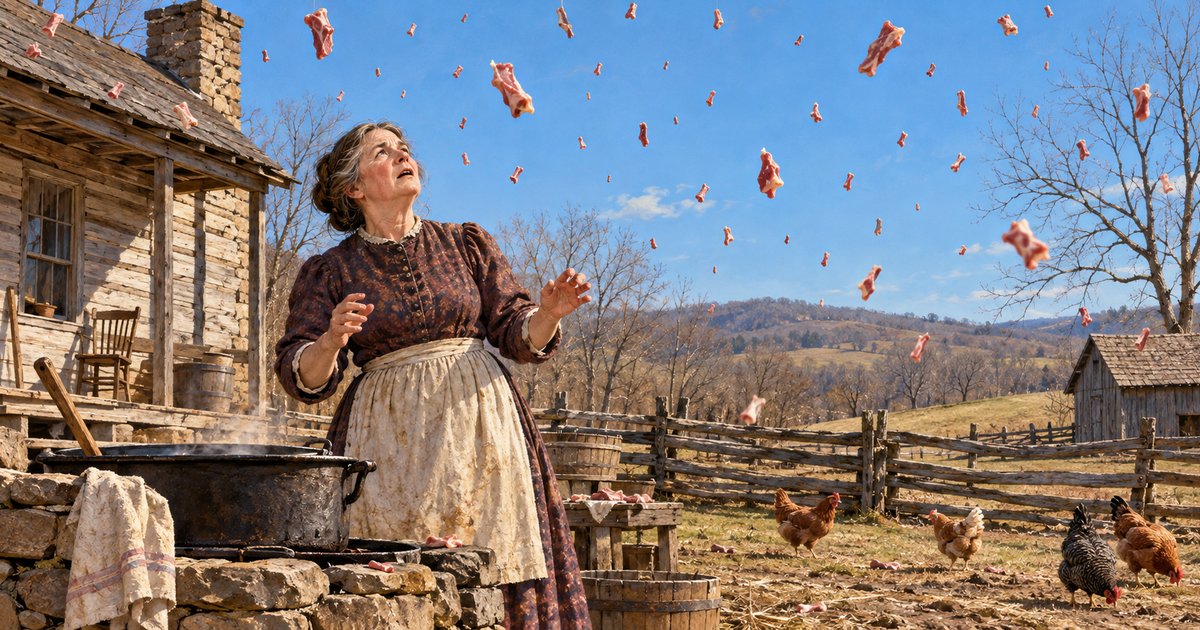
On what was described as a beautifully clear, sunny day, Mrs. Rebecca Crouch was in her yard making soap when the skies suddenly opened, and chunks of meat began raining down.
Like I said, weird.
According to early reports in The New York Times, small bits of meat fell from the sky like “large snowflakes”, while some were as big as four inches square. The meat rain apparently covered an area of approximately 100 yards by 50, or just over an acre of land.

Now, in case you’re unfamiliar, rain on Earth doesn’t usually include meat, unless we’re talking about fun animated movies. Nevertheless, meat rain is what poor Mrs. Crouch got on that spring day.
As unbelievable as the above may sound, it gets even stranger.
Far be it for me to tell you what to do, but when meat falls from the sky, I don’t recommend eating it. Though in spite of those best warnings, that is precisely what two unnamed gentlemen apparently did. The two men sampled the material and judged it to be either mutton or venison. Unfortunately, their names were omitted from the report, leaving posterity unable to thank them properly for their contribution to atmospheric cuisine.
Due to the nature of that reporting, we’re also left without the details of their decision. Did one suggest it and the other reluctantly agree? Was there a discussion about cooking? At what point does finding meat on a fence become an invitation to lunch?
Whatever their reasoning, the taste test supplied an opinion rather than an identification. Mutton or venison is a fairly broad verdict when the larger question is why either should be falling out of the sky.
Thankfully, a more scientific investigation took place soon after.
In a letter published in the Scientific American Supplement on July 22, 1876, Arthur Mead Edwards described tracing specimens through a small network of scientists and physicians. Dr. Allan McLane Hamilton and Dr. J. W. S. Arnold had examined one fragment and identified lung tissue. Edwards agreed, finding cartilage in it as well. Another specimen, previously offered as evidence for a vegetable explanation, also proved to be lung tissue.
The report included the unsettling comparison that the lung might have come from a horse or a human infant, whose tissue structures were described as similar.
Edwards’s conclusion was narrower and more useful: the specimens he examined were animal material. But even if they had correctly identified the species involved, the major question remained: why was it falling from the sky?
Edwards relayed what became a favourite local explanation. His letter suggested that a flock of buzzards had disgorged its meals overhead.
And there we have it: vulture vomit.

It is difficult to imagine a solution that could make the original event less appealing, but this one manages it.
Vultures can regurgitate food when threatened, and a flock passing above the farm could therefore have supplied both the animal tissue and the delivery system. Dr. L. D. Kastenbine also supported the explanation in the contemporary Louisville Medical News, arguing that disgorged carrion could account for the assortment of tissues being reported.
That may leave you a bit unsatisfied, though, and I’m right there with you. Not least because it boggles the mind that a flock of vultures large enough to spread vomit over an acre of land would go unnoticed by witnesses.
Other explanations did circulate in news reports, though; Leopold Brandeis proposed Nostoc as a solution, a gelatinous organism then discussed as a form of vegetable matter. Nostoc can swell when wet, making a previously inconspicuous patch on the ground seem to have appeared suddenly. Scientific American initially presented this as a solution, before Edwards’s microscopic findings challenged it.
William L. Alden, meanwhile, recognized that the affair required a much larger kitchen.
In “The Kentucky Meteors,” collected in his 1877 volume of pieces from The New York Times, the humorist entertained a meteoric explanation. If shattered worlds could leave rocky debris wandering through space, why should their former inhabitants escape the same fate? Perhaps Earth had encountered a supply of “cosmic meat.”
As silly as that satire may be, it serves to highlight the fact that we still don’t really know what happened that day. We can favour an explanation without pretending that every missing detail has obligingly turned up. An event can be natural and still be wonderfully peculiar.
And beneath all the analysis is Mrs. Crouch.
Before the specimens circulated, before the microscopes came out, before Alden stocked the solar system with venison, she was simply outside making soap.
Then meat began falling around her.
Whatever the vultures were doing, she had every reason to consider it a very strange day.




Leave a Reply