Just inside my front door sits a wooden walking stick. It leans into the corner, waiting patiently for my next adventure into the wilds. If you could ask it, it might lament how much time passes between each use, but even so, it waits for me. It’s well worn and comfortable in the hand, and it has accompanied me to places far and wide. But what, if anything, will happen to it when I’m gone?
Surely it will survive for generations. Probably not in its current position, but certainly it will exist on this planet for many years to come. Wherever time takes it, it will eventually succumb to rot and deterioration. It is wood, after all, and wood has a shelf life, if you will. A century from now, there may be nothing left to suggest that it ever existed at all.
In five thousand years, if some record of my life remains, how will archaeologists be able to reconstruct an accurate picture of my time on Earth if the things that accompanied me through it have disappeared in time? After all, that is the pursuit of archaeology in a nutshell: find traces of the elements that accompanied historic peoples through their lives, and from them infer who those people were. It is the study of what survived, rather than the study of everything that existed.
An entire epoch, the Stone Age, is defined by precisely that measure. It’s just that most of what survived from that era happens to be stone, because stone tends to stick around for a while. That, of course, does not mean that stone tools were the only technology available to those people. It simply means other elements of their lives didn’t survive the long march of time, which necessarily gives us an incomplete picture. In archaeology, this is known as preservation bias, where some materials are more likely to survive than others, potentially distorting our understanding of what life was like.
But science isn’t without its wiles, and an ever more complete picture is constantly being generated.

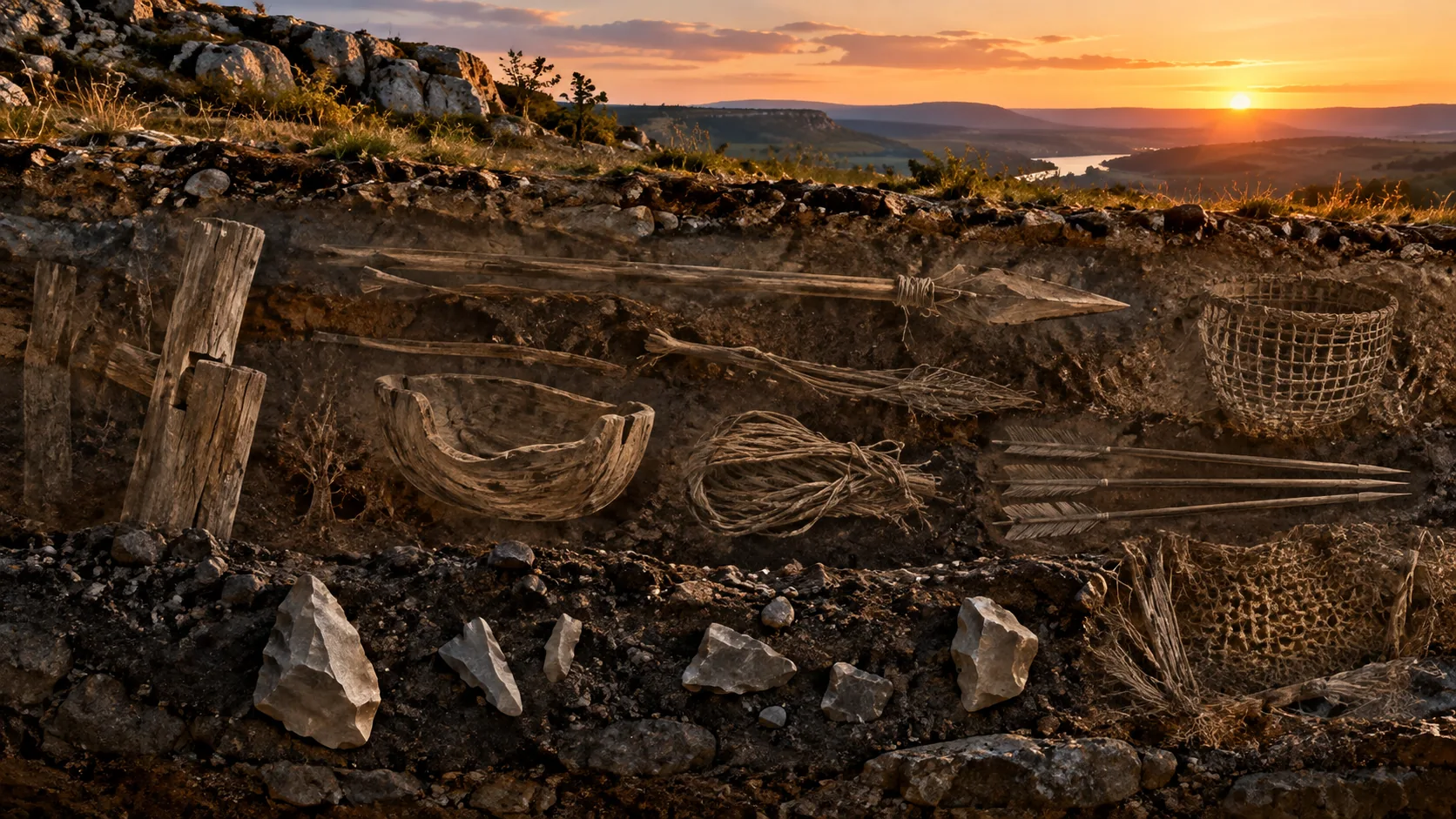
At an archaeological site in Spain known as Abric Romaní, researchers have uncovered remarkable evidence of a technological world that has largely vanished from the prehistoric record.
Published in the journal Science Advances, the research examines nearly six hundred wooden remains and impressions from 16 archaeological layers dating to approximately 62,000–40,000 years ago.
As mentioned, finding wooden samples in an archaeological record as old as this is quite rare, though it should be noted that most of what they found isn’t actually the wood itself. In large part, it’s environmental evidence of wood, or impressions, that they’re studying. The site at Abric Romaní provides good evidence of refined use of wood through highly detailed impressions left in the travertine stone. Together, these traces are revealing a previously invisible dimension of Neanderthal technology, one that would otherwise have been lost to time.
Among the nearly six hundred remains, researchers identified thirteen elements manufactured or used by Neanderthals, including two wooden spears, domestic implements, and possible structural components. The discoveries expand our understanding of how extensively these ancient people incorporated wood into their everyday lives.
And this is hardly an isolated example. While the discoveries at Abric Romaní offer a glimpse into the wooden technologies of Neanderthals tens of thousands of years ago, evidence from another archaeological site, this time in Zambia, suggests that our ancestors were using surprisingly sophisticated woodworking techniques nearly half a million years ago.
At Kalambo Falls, archaeologists uncovered two deliberately modified wooden logs, one fitted into a notch cut into the other, dating to approximately 476,000 years ago. Their precise purpose remains uncertain, but the discovery suggests that early hominins were doing considerably more with wood than simply gathering branches for fuel or fashioning rudimentary implements.
If we also consider the much younger Stone Age arrows recovered by Norway’s Secrets of the Ice project, including examples with intact wooden shafts and other elements of their construction preserved in ice, we’re forced to conclude that the use of wood as a technological material is something that’s been with humanity for a very long time. Indeed, even early hominins are known to have altered the wood in their surroundings to better suit their needs.
But what of the technologies for which no evidence survives at all? What ingenious applications of wood, bark, plant fibres, or other organic materials might have been developed and subsequently disappeared without leaving the slightest trace? We can scarcely begin to answer such questions, because we have no way of knowing what we’re missing. The discoveries discussed above offer glimpses into that vanished world, but they cannot tell us how much of it remains invisible. They simply expose that there are unknown unknowns for which we no longer have evidence to guide us.

It’s amazing what we can infer from indirect evidence, but perhaps even more remarkable is what we cannot know from evidence that no longer exists. Every discovery of an ancient wooden implement, every impression preserved in stone, and every artefact emerging from melting ice reminds us that the archaeological record is not a complete inventory of human ingenuity. It is merely what time has allowed us to find.
The familiar caricature of Neanderthals as lumbering, slow-witted creatures living simplistic lives is increasingly difficult to reconcile with the archaeological evidence. Discoveries such as those at Abric Romaní reveal a technological sophistication that the surviving record has only begun to illuminate. The ingenuity we so readily associate with modern humanity has much deeper roots than the surviving archaeological record might suggest. Humans have been using the materials in our environment to make our lives easier for so long that those materials have long since disappeared.
And somewhere in that incomplete record, perhaps, are the countless walking sticks that accompanied our distant ancestors through their own adventures into the wilds.






Leave a Reply