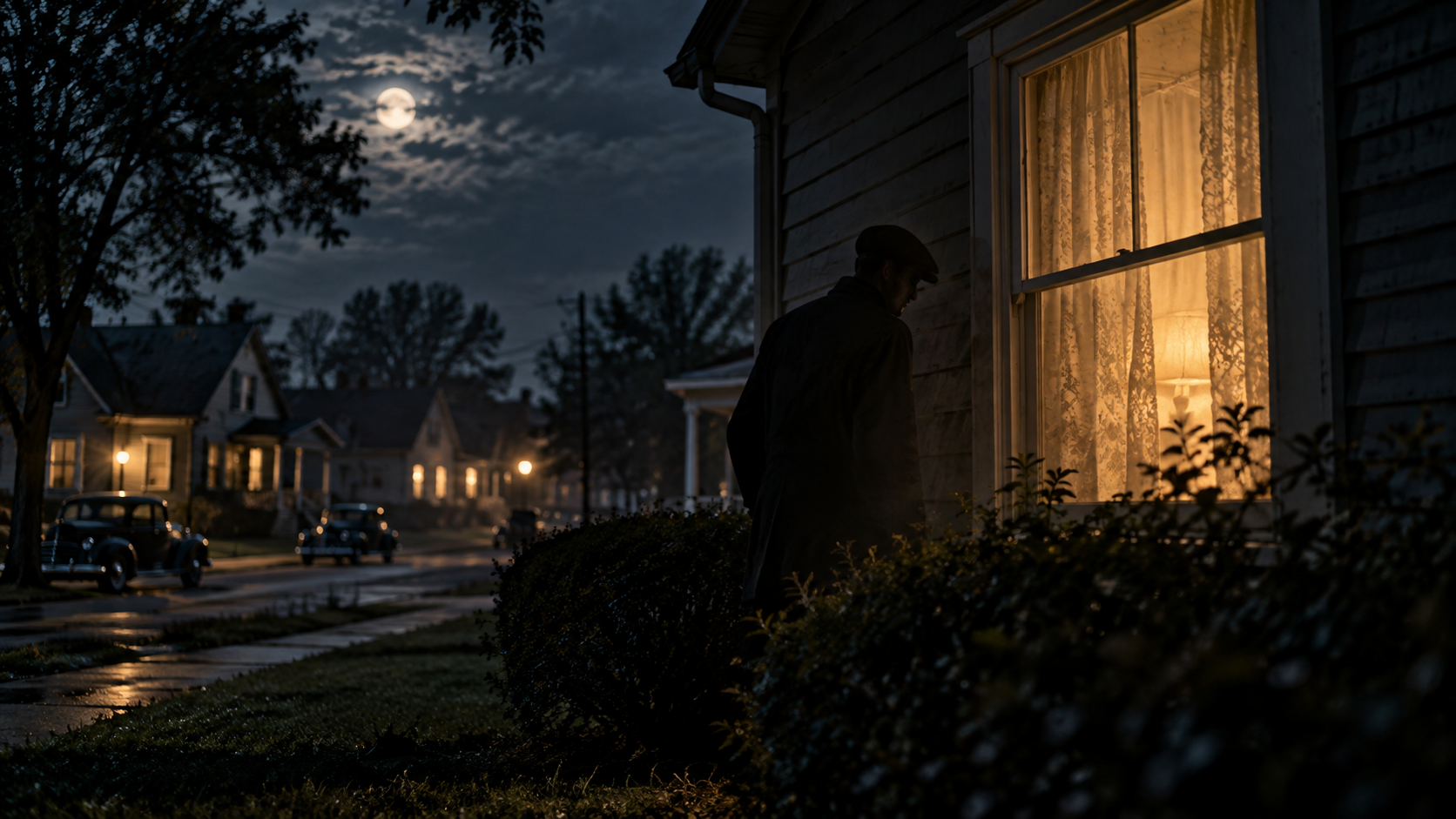
In September 1944, while Allied armies fought their way across Europe, the people of Mattoon, Illinois, had a somewhat more immediate problem. Someone was sneaking around town at night and gassing them through their bedroom windows.
Beginning in late August and carrying over into early September, residents reported the smell of a strange gas entering their homes and causing some serious symptoms, such as nausea, vomiting, coughing, and, most notably, the loss of feeling in their lower bodies.
Though not the first to report an experience, that of Aline Kearney deserves a closer look.

Late on the evening of Friday, September 1, 1944, Kearney reported smelling a sickly sweet odour reminiscent of flowers wafting through her bedroom window. As the smell intensified, she began to lose feeling in her legs. Her husband, Bert, later reported encountering a tall, thin man dressed in dark clothing and wearing a tight-fitting cap near the house. Kearney’s subsequent report to the local police resulted in the first news coverage of the growing incident—coverage that quickly got out of hand.
In no time at all, the small city of Mattoon was rife with rumour and fear over what ultimately became known as the attacks of the Mad Gasser. Over the next week or so, news reports became more and more dramatic, with headlines such as Anesthetic Prowler on the Loose!, Mad Anesthetist Strikes Again!, and eventually Mad Gasser Adds Six Victims! By the time the strange episode had run its course, nearly 30 people had reported being victims of the mysterious gas.
As mentioned, the police became involved quite early on, investigating reports and collecting what little evidence they could find. But to everyone’s dismay, no culprit was ever found. No spraying apparatus, no trace of any gas, and no overt cause was ever presented to explain these weird occurrences.
Police and other experts offered several potential candidates for the gas being used. The most plausible at the time were carbon tetrachloride and trichloroethylene, both industrial solvents. And there was even a connection to a local industry.
With a population of approximately 15,000 people, Mattoon was also producing important munitions and engines for the war effort. One early suspect was the Atlas Imperial Diesel Engine Company, where both carbon tetrachloride and trichloroethylene were used. But the industrial-fumes theory quickly ran into problems. Company officials explained that they kept only a small quantity of carbon tetrachloride on hand for use in fire extinguishers, while no leaks of trichloroethylene had been reported. Perhaps more importantly, none of the workers at the plant reported experiencing symptoms similar to those attributed to the Mad Gasser.
Other candidates, such as chloropicrin, were suggested later on. Chloropicrin was a powerful irritant that had been used as a chemical-warfare agent during the First World War, making it an understandable suspect in the atmosphere of 1944. But, as with the other potential culprits, it presented problems of its own. None of the proposed chemicals could neatly account for the reported combination of strange odours, nausea, coughing, temporary paralysis, and rapid recovery.
Investigators eventually began to settle on a more mundane explanation. By about September 13, it was reported that state and local police had concluded that the Mad Gasser probably didn’t exist at all, and that Mattoon was instead experiencing a case of mass hysteria.
As unsatisfying as that may seem on the surface, later examinations of the case reached much the same conclusion. Psychologist Donald M. Johnson subsequently investigated the affair and published “The ‘Phantom Anesthetist’ of Mattoon: A Field Study of Mass Hysteria” in 1945. He argued that publicity, anxiety, and suggestion had caused people to interpret unrelated smells, illnesses, and suspicious activity through the newly established idea of a prowling gas attacker.
That doesn’t necessarily mean that Aline Kearney and the other supposed victims simply imagined what happened to them. Anxiety and expectation can produce very real physical symptoms, while otherwise ordinary smells and events can take on an entirely different significance when people are already frightened and looking for a threat. Perhaps there never was a single cause behind the strange events in Mattoon at all.
Whatever happened, the Mad Gasser was never caught. As quickly as the attacks had begun, they stopped, leaving behind a wonderfully strange little mystery from the closing years of the Second World War.







Leave a Reply